Can a Family Legally Live in an RV
Can a Family Legally Live in an RV: What the Law Actually Says
This is the question most families research quietly, half-hoping the answer clears the path and half-worried it shuts the door entirely. The good news is that families can and do legally live in an RV full time all across the United States. The more complete answer is that legality depends heavily on where you park, how you establish residency, and whether you understand the difference between federal classification, state law, and local zoning ordinances — because all three operate independently and sometimes in direct conflict with each other.
Getting this wrong puts your family in a fragile legal position where you can be required to move without notice or face fines that complicate your finances at the worst possible time. Getting it right opens up a lifestyle that tens of thousands of American families are living today — legally, deliberately, and on their own terms.
Here is the honest picture of what the law actually says.
Why There Is No Single Answer
The confusion families encounter when researching RV legality comes from one foundational fact: the federal government does not classify RVs as permanent dwellings. The U.S. Department of Housing and Urban Development defines recreational vehicles as vehicles intended for recreational use, travel, or temporary camping — not as primary residences.
That classification creates a legal ripple effect. Because an RV is legally a vehicle rather than a home, it falls under a patchwork of state vehicle codes, county zoning ordinances, and municipal regulations rather than a single unified housing law. There is no federal law that says families cannot live in an RV full time. What exists instead is, as one RV law expert put it, approximately 300 smaller laws that collectively say not here, not like that, not for that long.
This is why families who approach RV living with a clear legal strategy rather than a vague assumption succeed long-term. The lifestyle is entirely achievable — but it requires knowing which rules apply where you plan to be.
Where It Is Clearly and Solidly Legal
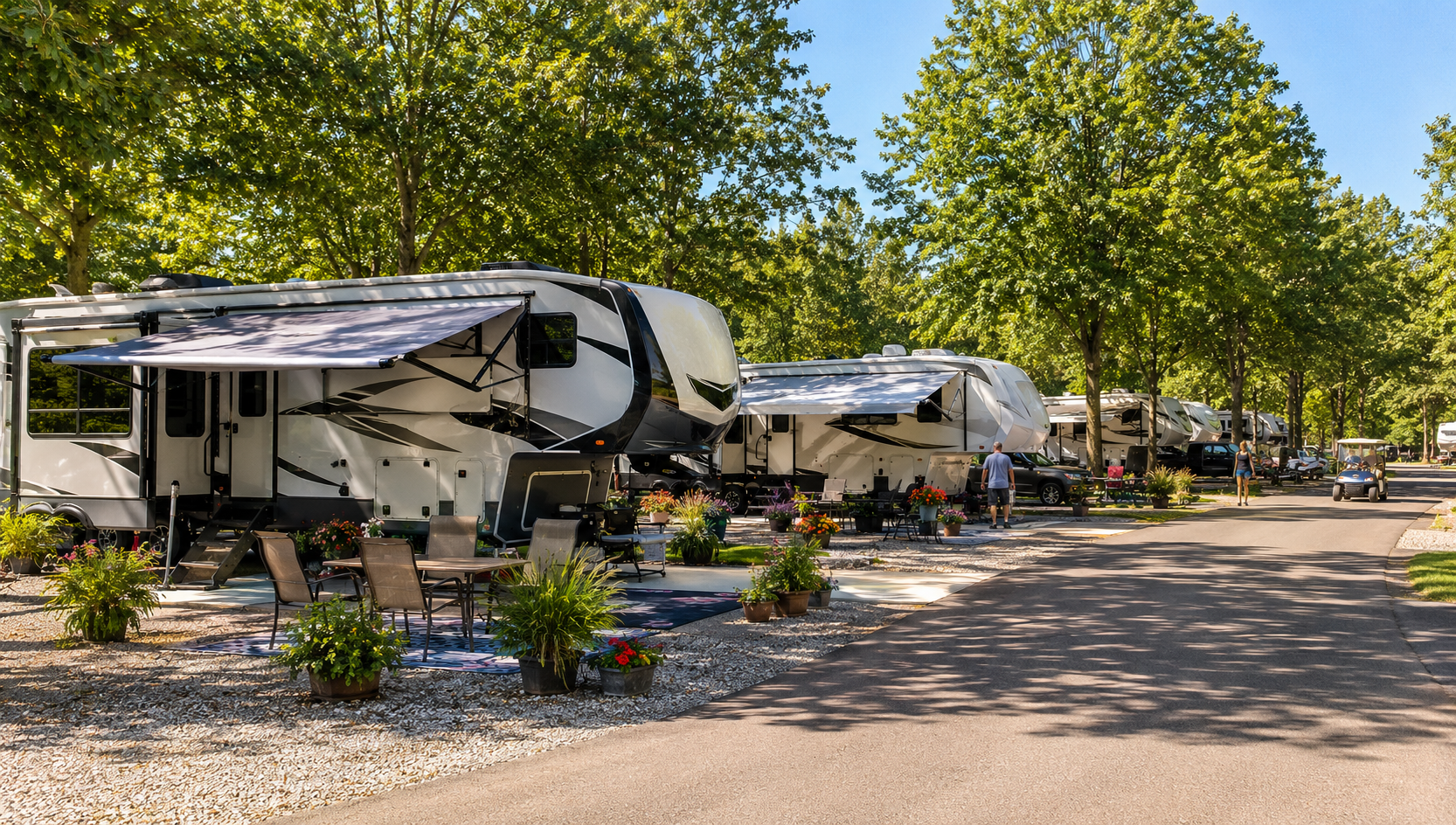
The most legally secure foundation for full-time family RV living is establishing residency at a licensed RV park or campground that permits long-term stays. These facilities exist precisely for human habitation — they are zoned, permitted, and built for it. Living at a licensed RV park gives your family a legal mailing address, utility connections through the park's licensed infrastructure, and a documented lease arrangement.
This is how the majority of full-time RV families structure their living situation, and it works because it operates entirely within the intended use parameters that RV parks are designed to support.
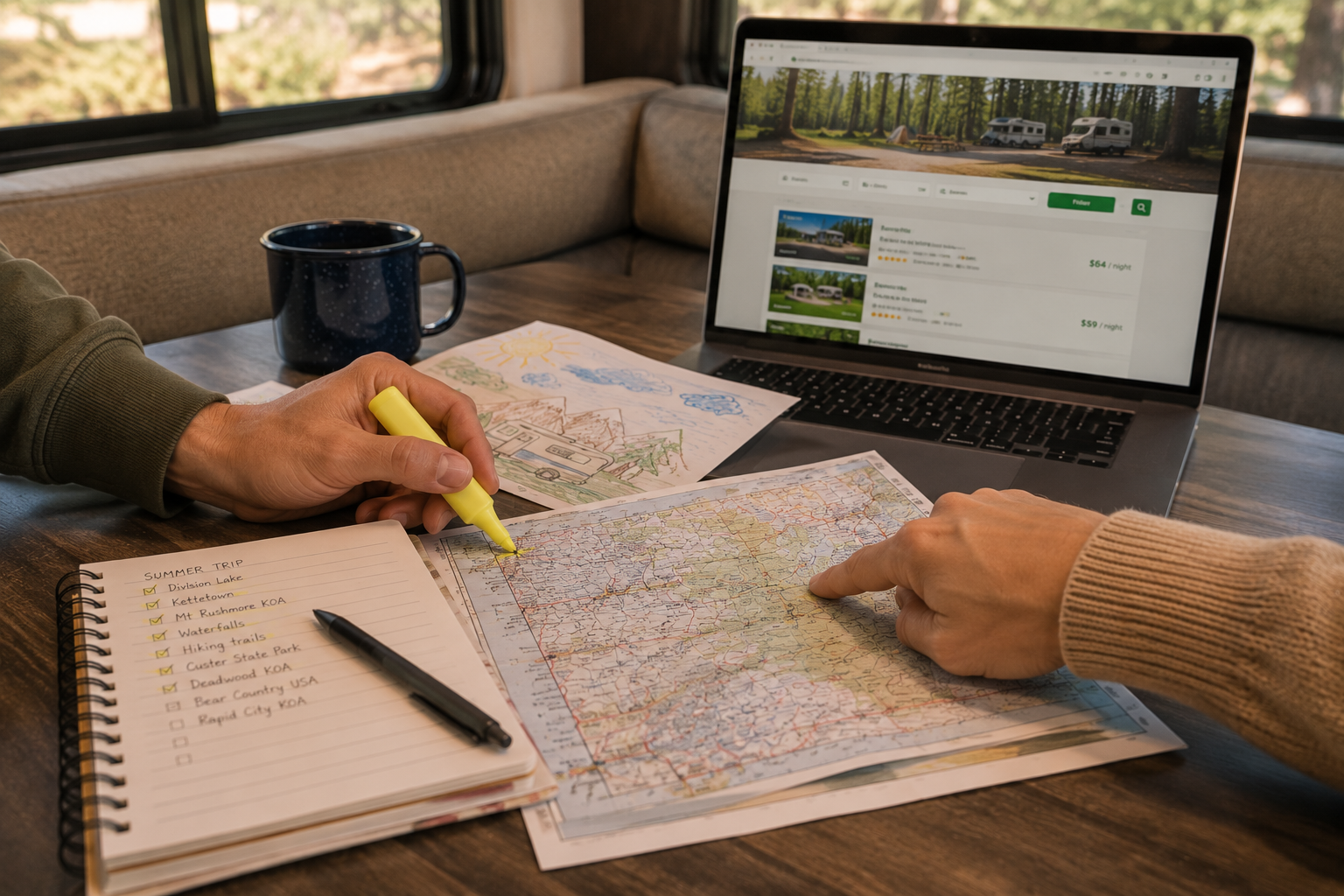
The second clean legal pathway is continuous travel. Families who move consistently between licensed campgrounds, state parks, national park campgrounds, and private RV parks are using RV facilities exactly as they are intended — temporarily and for travel. There is no legal challenge to this arrangement. Thousands of full-time traveling families operate this way permanently, staying weeks at a time in each location before moving on.
Where Families Run Into Legal Problems
The most common mistake families make is parking on private residential property — their own land, a family member's driveway, or a friend's backyard — and attempting to use the RV as their permanent home.
In most urban and suburban jurisdictions, this arrangement runs directly into local zoning ordinances that prohibit using a recreational vehicle as a residence on land zoned for standard housing. In Indiana, for example, the only places where families can legally live full time in an RV are licensed RV parks, resorts, and campgrounds. Living in an RV on private property — even your own — is not permitted beyond a 14-day window in most Indiana counties.
The legal picture differs by state. Texas and Florida both have provisions that allow RV living on private property under certain conditions. Texas permits citizens and their families to live in RVs on their own property provided the vehicle holds a valid Texas RV license and passes inspection — though HOA restrictions still apply in applicable neighborhoods. Florida similarly allows one RV to be parked and occupied on a residential property under specific placement conditions.
In Delaware and Hawaii, full-time RV living on private property is prohibited entirely.
Rural areas with minimal zoning enforcement are often more permissive in practice, and some families in genuinely rural counties do live on private land in RVs without issue. But relying on unenforced rules is a fragile legal position — enforcement priorities shift, neighbors complain, and properties change hands. A licensed campground or continuous travel arrangement is far more sustainable for a family committed to this lifestyle long-term.
Establishing Legal Domicile as a Full-Time Family
One of the most practically important legal decisions for full-time RV families has nothing to do with where they park — it is about where they are legally a resident. Every U.S. resident is required to maintain a legal domicile: a home state for driver's licensing, vehicle registration, voting, tax filing, and mail. For traveling families, this means choosing a domicile state deliberately rather than defaulting to wherever they used to live.
Three states dominate this conversation for specific and well-established reasons.
South Dakota has no state income tax, accepts campground stays as proof of physical presence for residency purposes, and has a well-organized process that full-time RV families have used reliably for decades. A short visit to establish presence, a stop at the DMV, and enrollment with a mail forwarding service is typically all it takes.
Texas also has no state income tax, accepts mail forwarding services as a valid domicile address, and has the largest active community of full-time RV families of any state in the country — meaning there is extensive peer knowledge available about how to navigate the process correctly.
Florida offers the same income tax advantage, warm weather as a natural anchor point for families who want a southern base, and a straightforward domicile process with well-established RV resident infrastructure.
For families based in Indiana, Iowa, or Illinois — the primary service states for Zoomers RV — South Dakota is typically the most efficient domicile choice given its proximity, minimal requirements, and specifically RV-friendly residency process.
Indiana-Specific Rules Zoomers RV Customers Should Know
Since Zoomers RV serves buyers primarily across Indiana, Iowa, and Illinois, it is worth being specific about Indiana's legal framework for full-time RV living.
Indiana does not recognize RVs as permanent residences under state housing law. Living in an RV on private property in Indiana — including in your own backyard, driveway, or on your own land — is not permitted under most county zoning codes beyond a temporary stay of up to 14 days. This applies across most of the state including Indianapolis, Terre Haute, Valparaiso, and surrounding municipalities.
The legal path for Indiana-based full-time RV families is to establish residency at a licensed Indiana RV park, resort, or campground — or to establish domicile in a more RV-friendly state such as South Dakota while traveling continuously. Indiana has excellent campgrounds and RV resorts throughout the state that accommodate long-term residents legally and comfortably, and many Zoomers RV buyers have made exactly this transition.
Children, Education, and Legal Obligations
Parents of school-aged children carry an additional layer of legal responsibility that applies regardless of where they park. Every state has compulsory education laws, and those laws apply to children living in RVs just as they apply to children in fixed homes.
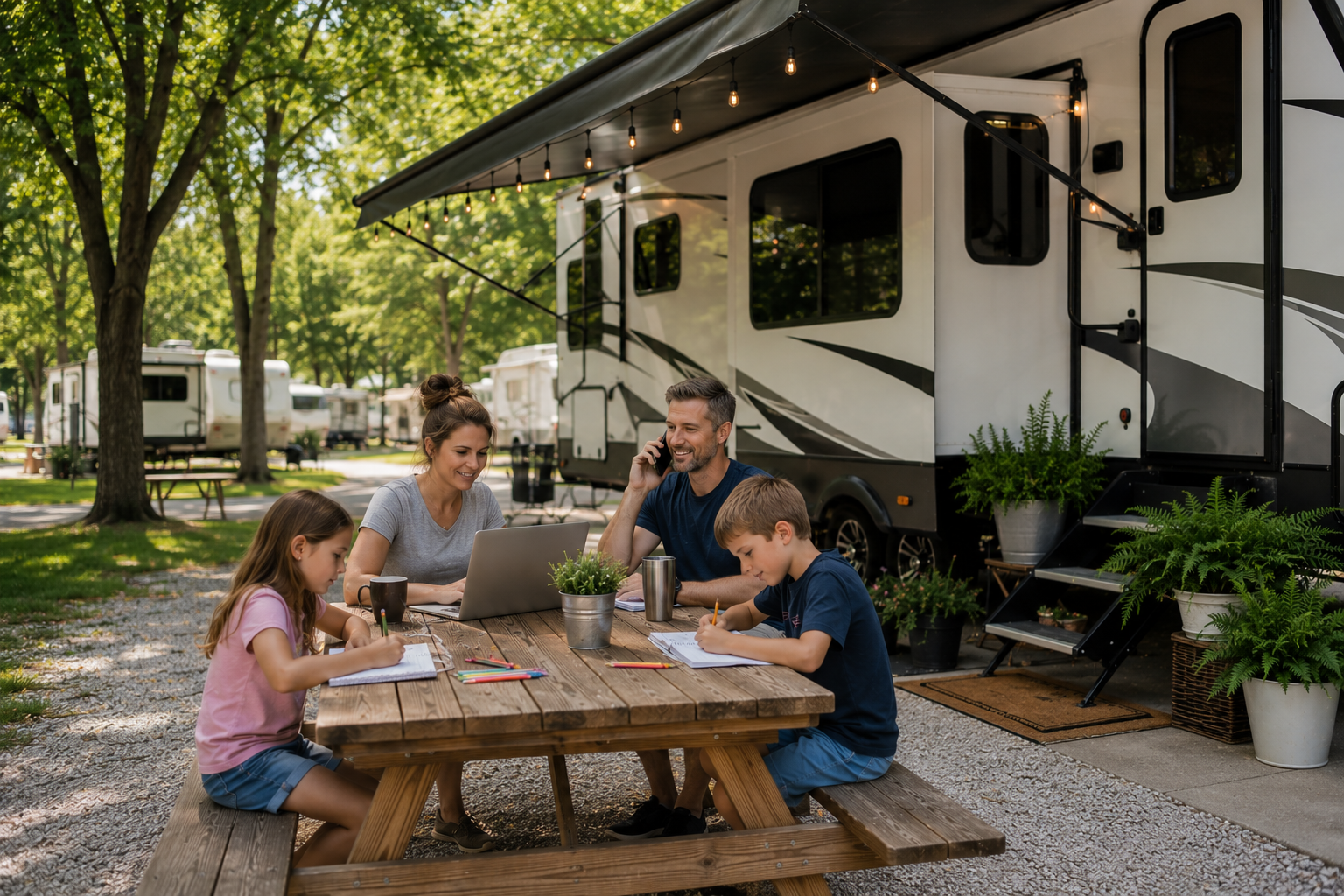
Homeschooling is legal in all 50 states, and it is the most common approach among full-time RV families. The reporting requirements vary significantly by state — some require annual notification to a school district, others mandate standardized testing, and several impose almost no formal requirements at all. Your domicile state's homeschool laws are the ones that apply to your family, which is one reason many families factor education regulations into their domicile state selection. South Dakota and Texas both have minimal homeschool reporting requirements compared to states like New York or California.
Families using accredited online virtual schools rather than independent homeschool curricula must enroll through their domicile state's program and ensure their travel schedule meets that program's daily participation requirements.
Practical Legal Setup Before You Leave
Two logistical pieces catch families off guard when they transition to full-time RV life — usually because they discover them mid-transition rather than before departure.
Health insurance plans built around an employer network or a specific state's marketplace provider system often provide almost no coverage outside that network. Families who travel full time across multiple states need a plan with nationwide provider access — specific ACA marketplace plans, faith-based coverage programs, or short-term health plans that accommodate multi-state travel are the options worth researching before you move.
Mail is solved through a dedicated RV mail forwarding service. Companies like Escapees, America's Mailbox, and Dakota Post provide a physical street address in your domicile state, scan incoming mail digitally, and forward physical items on request. This address functions as your legal residence for DMV registrations, banking, voter registration, and any other purpose requiring a fixed physical address. Setting this up before departure rather than improvising it after avoids the administrative headaches that derail many families in their first months on the road.
The Right Rig Makes Legal Full-Time Living More Manageable
Full-time family RV living is a legal and achievable lifestyle. The foundation it rests on is a rig built for the purpose. A fifth wheel or travel trailer constructed to weekend-use standards deteriorates quickly under the stress of full-time daily living — and a rig that constantly needs repairs keeps your family anchored to one location far longer than your campground permit allows.
Fifth wheels built for full-time use — with laminated wall construction, enclosed underbellies, residential-grade appliances, and robust slide-out systems — support the legal living arrangement you have set up by functioning reliably day after day. Brands like Keystone Montana, Grand Design, Alliance RV, and Forest River's Cardinal and Cedar Creek lines are the ones that full-time family buyers consistently come back to after researching seriously.
Zoomers RV carries new and used fifth wheels, toy haulers, and travel trailers across Indiana, Iowa, and Illinois — with a team that works regularly with buyers making the full-time transition. Understanding which rig matches your travel pattern, family size, and legal living plan is a conversation worth having with people who have walked hundreds of families through it. Browse the current inventory at Zoomers RV or connect with the team directly to start building your full-time plan from the right foundation.