

What Are the Main Types of RVs — and Which One Actually Fits Your Budget?
Most first-time RV shoppers walk onto a lot already overwhelmed. There are dozens of units, multiple configurations, and a vocabulary that sounds like its own language — fifth wheels, toy haulers, Class Cs, slide-outs. Before any of that makes sense, you need to understand what the core RV types actually are, what makes each one distinct, and how to match your lifestyle and financial reality to the right category.
Here's a clear-eyed breakdown of every major RV type — no filler, no jargon — so you can walk into any dealership knowing exactly what you're looking for.
The Two Fundamental Categories: Motorized vs. Towable
Every single RV on the market falls into one of two buckets: you either drive it or you tow it. That one distinction shapes your tow vehicle requirements, your campsite options, your storage needs, your insurance costs, and frankly your entire RV lifestyle. Getting this right before falling in love with a specific floor plan will save you a lot of headaches.
Motorized RVs — commonly called motorhomes — have their own engine and chassis. You get in, turn the key, and drive. Towable RVs have no engine; they hitch to your existing truck, SUV, or car and ride behind you. Towables are generally more accessible from an entry-cost standpoint and represent the majority of inventory you'll find at dealers like Zoomers RV.
Towable RVs: The Most Popular Category
Travel Trailers
Travel trailers are the single most popular type of RV sold in North America, and for good reason. They hitch to a standard ball mount on almost any qualifying tow vehicle — many full-size pickup trucks, SUVs, and even capable minivans. Floor plans range from compact 16-foot single-bedroom units to sprawling 35-foot models with multiple slide-outs, island kitchens, and residential bathrooms.
Their appeal is straightforward: once you're parked, you unhitch your tow vehicle and have a completely independent set of wheels to explore the area. You're not moving your entire home every time you want to grab groceries or drive to a trailhead. That separation of "home base" from "daily driver" is something motorhome owners genuinely envy.
At Zoomers RV, travel trailers are among the most consistently stocked categories — with brands like Forest River's Rockwood Geo Pro line and Keystone delivering an extensive range of floor plans suited to couples, families, and solo adventurers alike.
Fifth Wheel Trailers
Fifth wheels are the heavy-duty end of the towable market. They're towed by a pickup truck using a specialized in-bed hitch — the "fifth wheel" coupling — which distributes weight more evenly than a standard ball mount and allows for larger, taller units. The defining characteristic is the raised front bedroom loft that sits over the truck bed connection point, giving fifth wheels dramatically higher interior volume than most travel trailers at similar lengths.
If you're planning extended travel, full-time living, or simply want maximum living space without stepping into a motorhome, fifth wheels are frequently the answer. Keystone's Alpine line — including the Avalanche Edition — is one of the most respected fifth-wheel families in the industry, and it's a consistent part of the Zoomers RV lineup.
One important caveat: fifth wheels require a pickup truck with sufficient towing capacity and payload. If you're currently driving a half-ton truck, verify your specific truck's tow rating before falling for a heavier unit.
Toy Haulers
Toy haulers are travel trailers or fifth wheels built with one defining feature: a rear cargo garage. The back section of the unit converts between a living space and a garage compartment sized to carry ATVs, dirt bikes, kayaks, mountain bikes, or other recreational gear. When you reach camp, the ramp door drops and your equipment rolls right out.
For buyers who take off-road vehicles, motorcycles, or water sports equipment on every trip, a toy hauler eliminates the separate trailer — you consolidate your RV and your gear transport into one unit. Keystone's Impact series, stocked at Zoomers RV, is a strong example of what a well-built toy hauler delivers.
Pop-Up Campers (Folding Camping Trailers)
Pop-ups are the most compact and budget-accessible entry into the towable world. They collapse flat for towing — reducing wind resistance and making them towable by smaller vehicles — then expand at camp into a sleeping space using fold-out canvas or hard-sided tent sections. They're not designed for cold-weather camping or extended stays, but for fair-weather weekend trips on a tight budget, nothing gets you into the RV lifestyle more affordably.
Truck Campers
Truck campers load directly into the bed of a pickup truck. There's no separate tow vehicle, no hitch — the camper bolts or ties down into the bed and you drive as a single unit. They're compact, highly maneuverable, and capable of reaching backcountry sites that would stop any trailer in its tracks. The trade-off is interior living space — truck campers are designed for couples, not families.
Motorized RVs: Drive and Live in One Unit
Class C Motorhomes
Class C motorhomes are built on a truck or van cutaway chassis and are immediately recognizable by the over-cab sleeping area that extends above the driver's cab. They hit a genuinely useful balance — more interior space than a Class B, more manageable to drive than a full-size Class A, and solid family usability with sleeping for 6–8 in many configurations. Zoomers RV carries Class C motorhomes for buyers making the jump from towable into drivable.
Class B Motorhomes (Campervans)
Class B units are built on van chassis — typically a Mercedes-Benz Sprinter or Ford Transit — and are the most compact of the three motorhome classes. They're agile enough for city driving, fit standard parking spaces, and can access campsites that larger units can't. The Winnebago Solis and similar Class B campervans have attracted a wave of younger buyers drawn to the van-life aesthetic without the DIY conversion process. For buyers who value maneuverability and stealth camping flexibility above interior space, Class B delivers where nothing else does. Winnebago Class B units are available through Zoomers RV's inventory.
Class A Motorhomes
Class A motorhomes are the largest, most feature-rich units in the motorized category — built on commercial bus or heavy-duty truck chassis and ranging from 26 to 45 feet. They're designed for full-time living or long-haul cross-country travel with residential kitchens, king-sized beds, multiple slide-outs, and serious storage. Class A units are well-suited to retirees, full-timers, and buyers who genuinely use their RV as a primary residence.
How to Match RV Type to Your Real-World Situation
Understanding the categories is the first step — the second is honest self-assessment. Here's a practical way to think it through.
How many people are you accommodating? A couple has fundamentally different needs than a family of six. Floor plan selection and sleeping capacity should drive your shortlist before anything else.
What's your tow vehicle situation? If you already own a full-size pickup, you have access to most travel trailers and fifth wheels. If you're towing with an SUV, travel trailers and pop-ups are your lane. If you have no tow vehicle at all, a motorhome may make more sense than buying two vehicles.
How do you camp? Full hookups at a resort campground, primitive boondocking off the grid, or a mix? That shapes everything from tank capacities to solar setup priorities.
How often will you use it? Weekend warriors can get enormous value from a quality used travel trailer. Full-timers should prioritize build quality and long-term living comfort over a flashy sticker price.
Do you carry recreational equipment? If an ATV, dirt bike, or kayak goes with you on every trip, a toy hauler may eliminate the need for a separate equipment trailer entirely — simplifying your setup and your costs.
The best RV isn't the one with the most features or the longest floor plan. It's the one that honestly matches how you actually travel.
Find Your Type at Zoomers RV
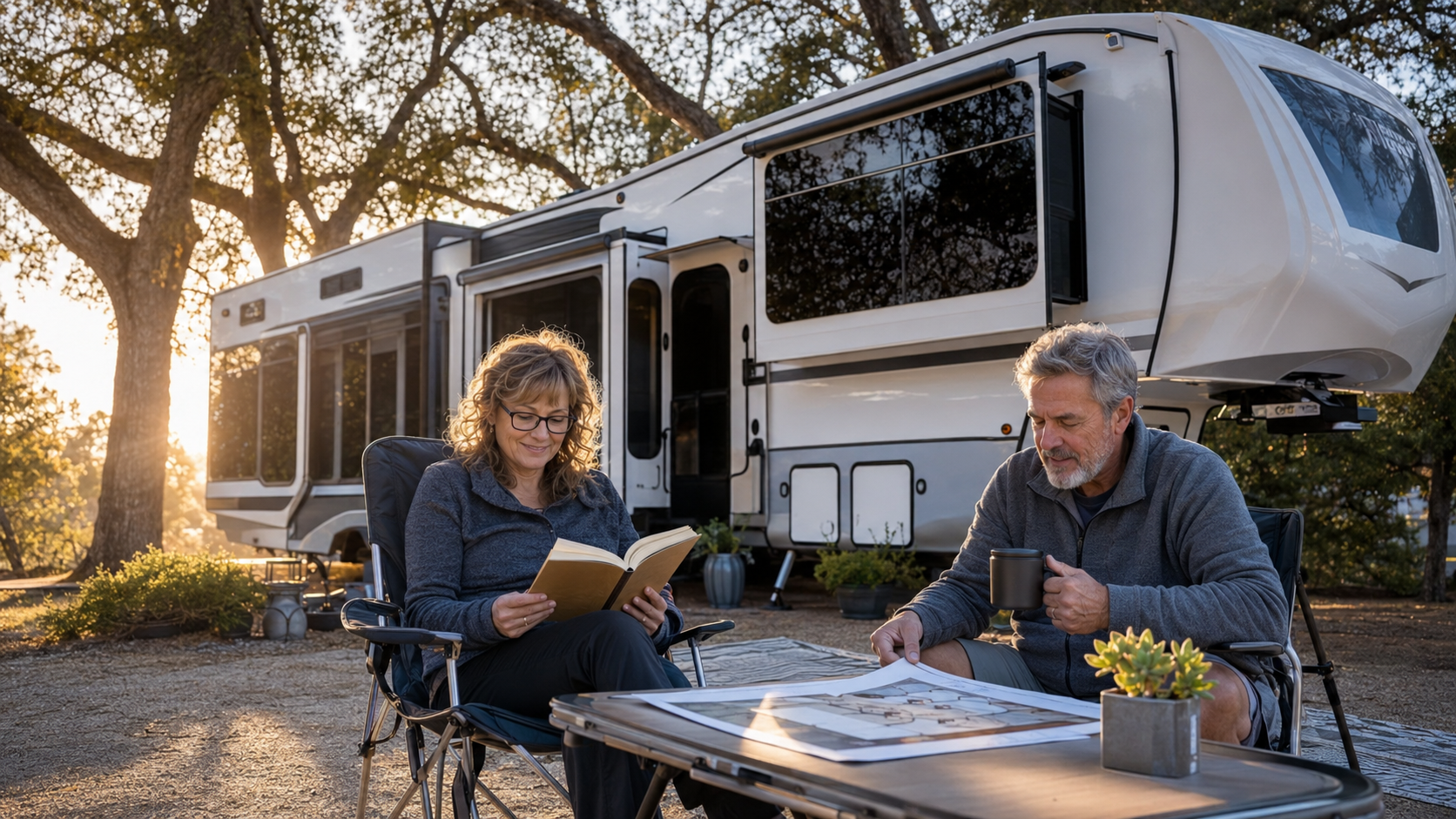
Zoomers RV carries new and used inventory across every major category — travel trailers, fifth wheels, toy haulers, Class C motorhomes, and Class B campervans — from trusted manufacturers including Forest River, Keystone, Jayco, Alliance RV, Grand Design, Coachmen, Dutchmen, and Winnebago.
With locations in Wabash, IN, and Ina, IL, our team is built to help you compare RV types side by side — not just stare at specs on a screen. Whether you're a first-timer trying to understand the difference between a fifth wheel and a travel trailer, or an experienced RVer ready to upgrade to a toy hauler, come in and let's figure it out together.
Browse our full inventory online or visit our Wabash showroom at 2503 E. State Rd. 524. Our team is here every step of the way — from your first question to your first trip.