

RV Towing Weight Capacity Explained: How to Calculate Safe Limits (2026 Guide)
Understanding RV Towing Weight Capacity: A Complete Guide
Determining how much weight your vehicle can tow involves calculating your vehicle's Gross Combined Weight Rating (GCWR) minus its actual loaded weight. Zoomers RV is your expert resource for matching the right camper to your truck or SUV, ensuring you travel safely without exceeding your payload or towing limits.
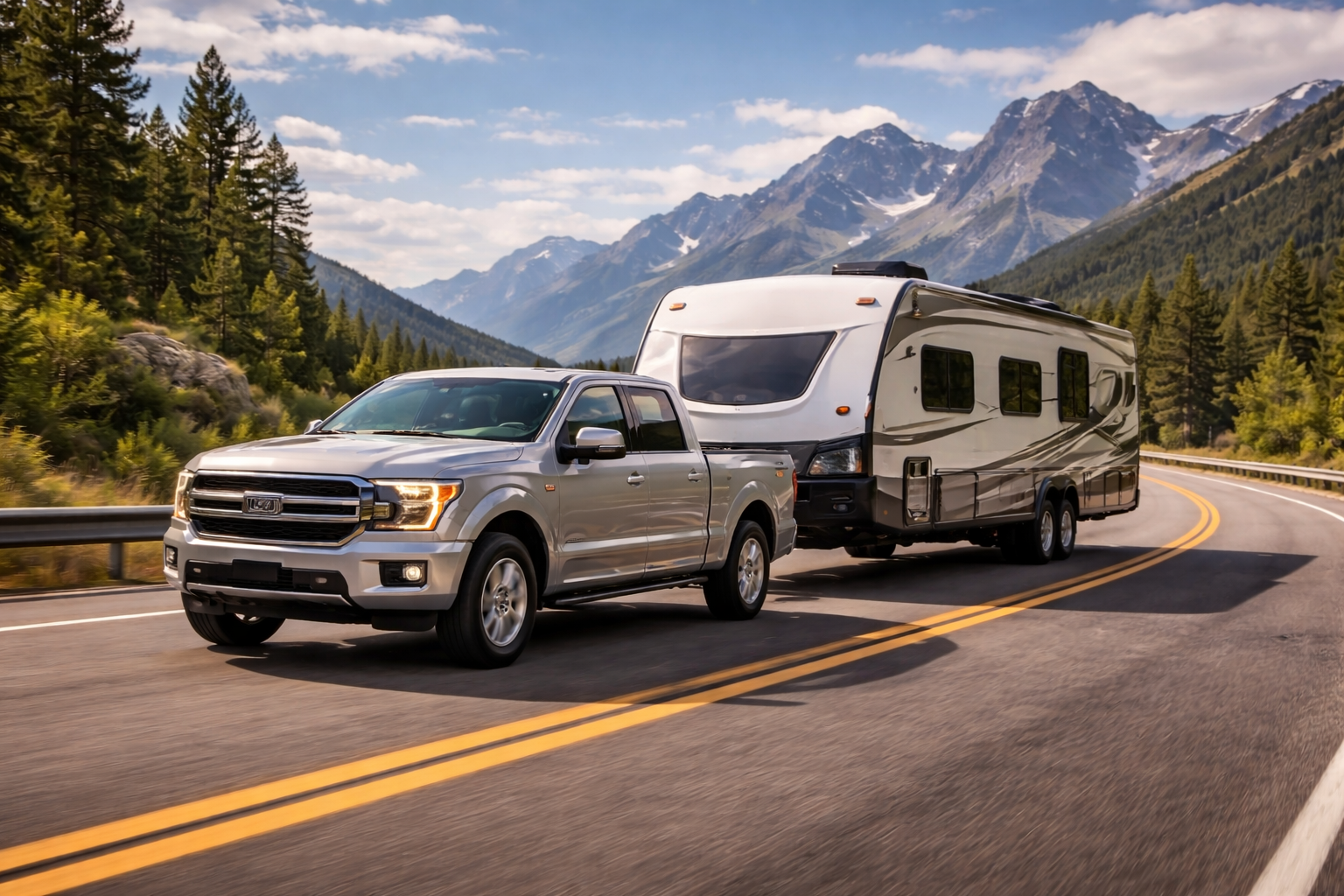
Why Understanding RV Towing Weight is Critical for Your Family
At Zoomers RV, our mission has always been about "Strengthening Families by Creating Memories That Matter." Nothing ruins a family vacation faster than a white-knuckle driving experience because your trailer is too heavy for your truck.
Whether you are browsing our selection in Wabash, IN, visiting us in Ina, IL, or checking out our latest arrivals in Lamoni, IA, understanding weight isn't just about math—it’s about safety. We want you to feel confident behind the wheel, whether you're heading to a local state park or taking advantage of our Nationwide Delivery to bring your new rig home to the coast.
The Essential RV Weight Vocabulary
Before you "Compare Apples to Apples" on pricing, you need to compare the specs. The RV industry loves acronyms, but they are simpler than they look.
GVWR (Gross Vehicle Weight Rating)
This is the absolute maximum weight your RV can safely weigh when fully loaded with water, propane, gear, and food. You should never exceed this number.
UVW (Unloaded Vehicle Weight)
Often called "Dry Weight," this is what the RV weighed when it left the factory. It does not include your personal gear, full water tanks, or even the battery in some cases.
Pro Tip: Never base your towing capacity solely on the UVW. Always look at the GVWR to be safe.
CCC (Cargo Carrying Capacity)
This is the "room" you have for your stuff. It is calculated by subtracting the UVW from the GVWR. If you’re packing for a large family in a Jayco Jay Flight, your CCC matters immensely.
GAWR (Gross Axle Weight Rating)
This is the maximum weight a single axle can handle. Even if your total weight is fine, if all your heavy gear is in the very back or very front, you might overload an axle.
How to Calculate Your Real Towing Capacity
Most people look at their truck's "Max Tow Rating" and think that’s the end of the story. In reality, your Payload Capacity is often the limiting factor.
Step 1: Check the Door Jamb. Look for the "Tire and Loading Information" sticker on your driver’s side door. It will say, "The combined weight of occupants and cargo should never exceed XXXX lbs." This is your payload.
Step 2: Account for the Family. Subtract the weight of all passengers, the dog, the fifth-wheel hitch (which can weigh 200+ lbs), and the tools in your truck bed.
Step 3: Calculate Tongue/Pin Weight. * Travel Trailers: Usually 10-15% of the trailer’s weight.
Fifth Wheels: Usually 15-25% of the trailer’s weight (often called "Pin Weight").
Step 4: The Comparison. If your remaining payload is 1,200 lbs, but your trailer's tongue weight is 1,400 lbs, you are overweight—even if your truck is rated to "pull" 10,000 lbs.
Matching the Right RV to Your Vehicle
We’ve grown from a single trailer in Wabash to a multi-state leader because we don't just sell you a camper; we help you find the right one.
Mid-Size SUVs (Towing 3,500 – 5,000 lbs)
If you drive a vehicle like a Chevy Traverse or Ford Explorer, you are looking for "Ultra-Lites."
Top Picks: Forest River Rockwood Geo Pro or smaller Cherokee Wolf Pup models. These provide the comforts of home without the massive footprint.
Half-Ton Trucks (Towing 7,000 – 10,000 lbs)
This is the most common category. However, many half-tons struggle with the "Payload" we mentioned earlier.
Top Picks: Jayco Jay Flight or Forest River Cherokee. These brands offer floor plans designed specifically to maximize space while keeping hitch weights manageable for F-150s and Silverados.
Three-Quarter and One-Ton Trucks (Towing 12,000+ lbs)
If you’re looking at luxury fifth wheels like the Alliance Paradigm or Keystone Montana, you’ll likely need a heavy-duty truck.
The Advantage: These trucks have the suspension and braking power to handle the high pin weights of large fifth wheels. The Alliance Avenue series is a great "mid-profile" option that offers luxury without requiring the world's largest truck.
The Zoomers RV "No Extra Fees" Guarantee
We know Midwest buyers are value-conscious. That’s why we encourage you to Compare Apples to Apples. Other dealers might show a low price online, only to add $2,000 in "Freight," "Prep," and "Admin" fees when you arrive.
At Zoomers RV:
The Price is the Price: No hidden "prep" fees.
Nationwide Delivery: We offer the lowest prices in the country—guaranteed. Even with shipping, we often beat local dealers by thousands.
No-Pressure Experience: We want you to understand your weight limits so you stay a customer for life.
Safety Tips for Your First Tow
Check Your Tires: RV tires (ST tires) often have a maximum speed rating of 65 mph. Check the sidewall before you hit the interstate.
Use a Weight Distribution Hitch: For travel trailers, a good WDH with sway control is a game-changer for stability in the wind.
The 80% Rule: Many experienced RVers recommend only towing up to 80% of your max capacity. This gives you a safety margin for steep mountain grades or heavy headwinds.
Frequently Asked Questions
Does "Dry Weight" include my water tanks?
No, Dry Weight is the empty unit.
Unloaded Vehicle Weight (UVW) is measured with empty fresh, grey, and black tanks. A full 50-gallon fresh water tank adds about 417 lbs to your trailer. If you plan to "boondock" or camp without hookups, always account for the weight of your water.
Is a Fifth Wheel easier to tow than a Travel Trailer?
Generally, yes, because of the hitch location.
Since a fifth wheel hitches over the rear axle of the truck rather than the bumper, it is much more stable and less prone to "sway." However, they are significantly heavier and require a larger truck (usually a 2500/3500 series).
Can I tow a camper with a minivan?
Yes, but your options are limited.
Most modern minivans have a towing capacity of 3,500 lbs. This is perfect for pop-up campers, teardrop trailers, or ultra-light fiberglass campers. Always check if your van requires a "tow package" (extra cooling for the engine/transmission) to hit that 3,500 lb limit.
How do I find my truck's GCWR?
It is usually found in the owner's manual or via a VIN lookup.
The Gross Combined Weight Rating is the maximum allowed weight of the truck and the trailer together. Unlike the payload sticker, this is often not on the door jamb. You can call your local vehicle dealer with your VIN, and they can give you the exact spec for your specific build.