
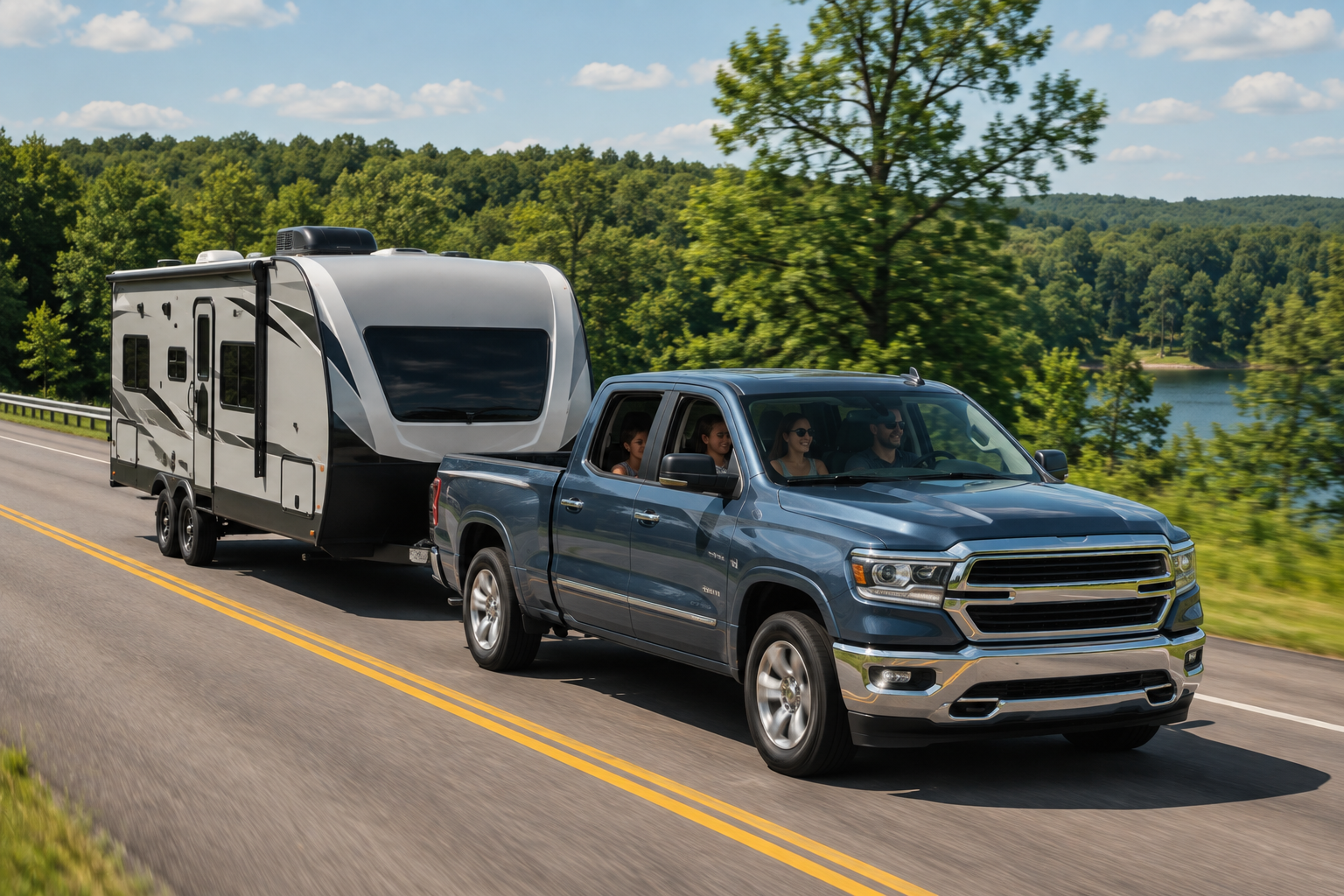
Can a Half-Ton Truck Tow a Travel Trailer?
Yes, a half-ton truck can tow many travel trailers, but not every half-ton truck can safely tow every travel trailer.
Trucks such as the Ford F-150, Chevrolet Silverado 1500, GMC Sierra 1500, Ram 1500, and Toyota Tundra are popular tow vehicles because they combine everyday usability with substantial towing capability. However, the actual amount your truck can tow depends on its engine, drivetrain, axle ratio, cab configuration, bed length, tow package, payload rating, and other equipment.
The travel trailer matters just as much.
Zoomers RV currently carries hundreds of travel trailers ranging from compact lightweight campers under 3,000 pounds to much larger models weighing well over 8,000 pounds empty. That means some trailers can pair comfortably with certain half-ton trucks, while others may be better suited to a three-quarter-ton or one-ton truck.
The key is understanding the numbers before you hitch up.
How Much Can a Half-Ton Truck Tow?
There is no single towing capacity that applies to every half-ton pickup.
Depending on configuration, a modern half-ton truck may have a maximum advertised towing capacity somewhere within or even beyond the roughly 7,000- to 10,000-pound range commonly associated with this truck class.
But the manufacturer's maximum advertised number should never be treated as the automatic towing limit for your specific truck.
Your actual truck may have a lower limit because of its:
Engine
Transmission
Cab configuration
Bed length
Four-wheel-drive system
Axle ratio
Installed options
Tow package
Payload capacity
The safest approach is to identify the ratings for your truck's exact VIN and configuration rather than relying on an advertisement for the model line.
Zoomers RV's towing guide also notes that half-ton pickups are commonly used with trailers in the 7,000- to 10,000-pound towing category, while emphasizing that payload often becomes the limiting factor before maximum tow rating does.
Towing Capacity Is Only Part of the Equation
One of the most common mistakes when shopping for a travel trailer is looking only at maximum towing capacity.
Suppose your truck is rated to tow 9,500 pounds and you find a trailer with a dry weight of 7,000 pounds.
At first glance, the combination may appear perfectly acceptable.
But towing safety depends on several additional weight ratings.
You need to consider:
Payload capacity
Tongue weight
Gross Vehicle Weight Rating
Gross Combined Weight Rating
Trailer GVWR
Passenger weight
Cargo in the truck
Hitch equipment
Water and cargo inside the trailer
Ignoring any of these can result in an overloaded truck even when the trailer technically weighs less than the truck's maximum towing rating.
Payload Capacity Can Be the Real Limit
For many half-ton truck owners, payload is the number that deserves the most attention.
Payload represents how much weight the truck can carry, not how much it can pull.
That includes the weight of:
Driver and passengers
Luggage
Tools
Coolers
Cargo in the truck bed
Hitch equipment
The trailer's tongue weight
Every pound placed in or on the truck reduces the payload available for supporting the trailer.
This is why two trucks with similar advertised tow ratings may have very different real-world trailer limits.
A crew-cab truck loaded with four passengers, camping gear, and a full bed can use a significant portion of its payload before the trailer is even attached.
What Is Travel Trailer Tongue Weight?
Tongue weight is the amount of the trailer's weight pressing downward on the hitch.
For conventional travel trailers, tongue weight commonly represents roughly 10% to 15% of the loaded trailer weight.
For example, a loaded 7,000-pound travel trailer could place approximately 700 to 1,050 pounds on the hitch.
That weight counts against the truck's payload capacity.
Add four passengers, a weight-distribution hitch, tools, coolers, and other gear, and it becomes easy to exceed the truck's payload rating even though the trailer is still below its advertised maximum towing capacity.
This is why payload and tongue weight should always be calculated together.
Dry Weight Is Not Your Camping Weight
Another common mistake is comparing the truck's tow rating only with a travel trailer's advertised dry weight.
Dry weight, sometimes referred to as unloaded vehicle weight, generally represents the trailer before you load your camping supplies, food, water, clothing, outdoor furniture, batteries, propane, and other gear.
That extra weight adds up quickly.
Zoomers RV's towing guide points out that a full 50-gallon fresh-water tank alone adds roughly 417 pounds because water weighs approximately 8.34 pounds per gallon.
A trailer that weighs 6,000 pounds empty may therefore be considerably heavier by the time your family is ready to leave for the campground.
When comparing trailers, look closely at the trailer's GVWR, not just its dry weight.
What Travel Trailer Weight Is Best for a Half-Ton Truck?
There is no universal maximum because half-ton trucks vary substantially.
Still, shoppers often have the best experience when they choose a trailer that leaves a reasonable margin beneath the truck's limits rather than selecting the heaviest trailer the truck can theoretically tow.
Zoomers RV carries many trailers in weight ranges that can work with appropriately configured half-ton trucks.
For example, its current Wabash inventory includes travel trailers such as a Forest River Salem Cruise Lite at approximately 5,975 pounds dry and a Forest River Rockwood Ultra Lite at approximately 6,554 pounds dry.
That does not mean every F-150, Silverado 1500, Ram 1500, or similar truck can automatically tow those trailers.
It means they may fall within the range worth investigating once the exact truck's payload, tow rating, hitch rating, and combined weight limits are confirmed.
Lightweight Travel Trailers Give Half-Ton Owners More Flexibility
If you want to stay comfortably within your truck's limits, a lightweight or ultra-light travel trailer can be an excellent place to start.
Zoomers RV currently lists compact travel trailers such as the Modern Buggy Country Born at approximately 2,850 pounds dry and Forest River Rockwood Geo Pro models in lightweight configurations.
A lighter trailer can provide several benefits:
More payload margin
Less stress on the tow vehicle
Easier acceleration
More flexibility for passengers and cargo
Easier maneuvering
Greater margin when traveling through hills or windy conditions
However, lightweight does not automatically mean safe for every truck.
You still need to verify all manufacturer ratings.
How Do You Know What Your Half-Ton Can Actually Tow?
Start with your truck itself.
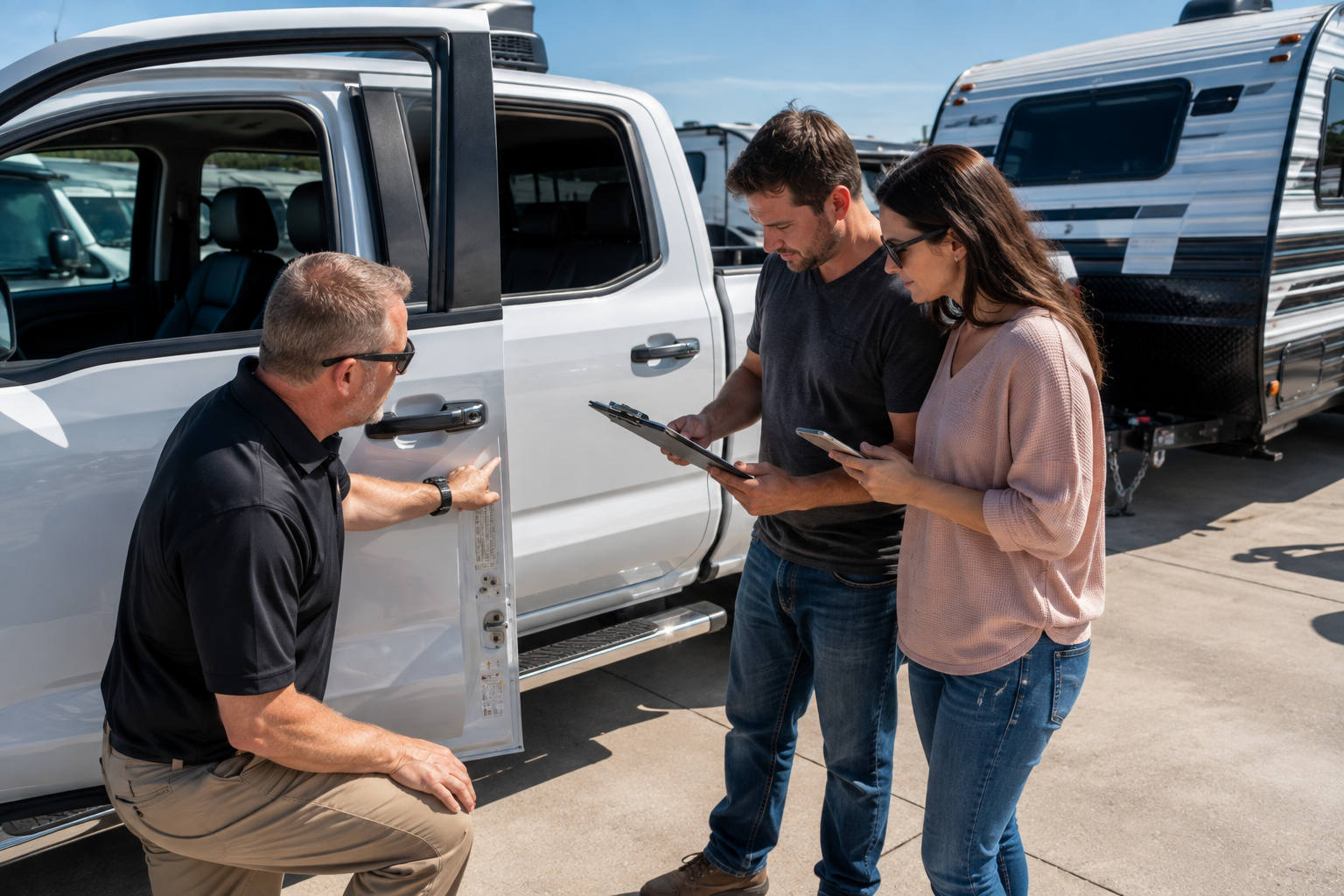
Look at the certification and tire-loading labels on the driver's door or door jamb.
You should also check the owner's manual, towing guide, or manufacturer VIN lookup information for your exact configuration.
Important ratings include:
Payload Capacity
This tells you how much weight the truck can carry.
Remember that tongue weight counts as payload.
GVWR
The Gross Vehicle Weight Rating is the maximum allowable weight of the fully loaded truck.
That includes the truck, passengers, cargo, hitch, and trailer tongue weight.
GCWR
The Gross Combined Weight Rating represents the maximum permitted combined weight of the truck and trailer.
Zoomers RV's towing guide explains that comparing GCWR with the actual loaded weight of the truck is an important part of calculating safe trailer capacity.
Maximum Tow Rating
This is the maximum trailer weight the manufacturer allows for the specific truck configuration.
Do not assume the highest number advertised for the model applies to your individual truck.
Hitch Rating
The receiver hitch itself also has a maximum weight rating.
Your towing setup should never exceed the rating of the weakest component.
Should You Use a Weight-Distribution Hitch?
For many larger travel trailers, a properly selected weight-distribution hitch can improve stability and distribute hitch loads more effectively between the tow vehicle and trailer axles.
Many systems also incorporate sway control.
Zoomers RV recommends weight-distribution and sway-control equipment as part of a stable travel-trailer towing setup, particularly when trailer size and tongue weight increase.
However, a weight-distribution hitch does not increase your truck's legal payload or towing ratings.
It cannot make an overloaded truck safe.
Always follow the truck, hitch, and trailer manufacturers' instructions when selecting and setting up towing equipment.
What About Trailer Sway?
Trailer sway occurs when a travel trailer begins moving from side to side behind the tow vehicle.
Several factors can contribute to sway, including poor weight distribution, excessive speed, improper tire pressure, strong crosswinds, and an incorrectly set up hitch.
Zoomers RV recommends proper cargo distribution, correct tire pressures, safe driving speeds, weight-distribution equipment where appropriate, and sway-control devices to help maintain stability.
A larger truck does not automatically eliminate sway.
Proper trailer loading and hitch setup remain essential.
Should You Follow the 80% Towing Rule?
You may hear RV owners recommend towing no more than about 80% of a truck's maximum rating.
This is not a universal manufacturer requirement, but some RVers use it as a personal safety margin to provide extra capacity for cargo, grades, wind, and changing road conditions.
Zoomers RV's towing guide also discusses this approach as a commonly used rule of thumb rather than an official replacement for manufacturer ratings.
The more important rule is simple:
Never exceed any of the truck, trailer, tire, axle, hitch, payload, GVWR, or GCWR ratings.
A safety margin can be useful, but it does not replace proper calculations.
Can a Half-Ton Tow a 7,000-Pound Travel Trailer?
Possibly.
A properly equipped half-ton truck may have enough towing capacity for a 7,000-pound trailer.
But you still need to determine whether that 7,000 pounds represents dry weight or loaded weight.
You also need to calculate expected tongue weight and compare it against the truck's available payload after passengers and cargo are added.
A truck rated to tow 10,000 pounds might still have insufficient payload for a particular 7,000-pound travel trailer once the family and camping equipment are aboard.
Can a Half-Ton Tow an 8,000-Pound Travel Trailer?
Some can, but this is where careful calculations become increasingly important.
An 8,000-pound loaded trailer can create substantial tongue weight, especially once batteries, propane, cargo, and water are included.
Larger trailers may also present more surface area in crosswinds and put greater demands on the truck's suspension and braking system.
If your trailer pushes your half-ton close to its payload, axle, or combined-weight ratings, moving to a three-quarter-ton truck may provide a more comfortable towing setup.
Can a Half-Ton Tow a 10,000-Pound Travel Trailer?
Certain properly configured half-ton trucks may have advertised tow ratings around or above 10,000 pounds.
That does not mean towing a 10,000-pound travel trailer is appropriate for every truck carrying a half-ton badge.
Payload is often the limiting factor.
At this weight level, tongue weight alone can consume a large percentage of the truck's available payload before passengers and cargo are added.
If you are consistently shopping near the upper edge of a half-ton's capabilities, it is worth comparing the numbers with a three-quarter-ton truck rather than choosing solely on maximum tow rating.
When Should You Consider a Three-Quarter-Ton Truck Instead?
A heavier-duty truck may be worth considering if you:
Want a particularly large travel trailer
Regularly travel with several passengers
Carry significant cargo in the truck bed
Frequently travel through mountains
Plan long cross-country towing trips
Are consistently close to payload limits
Want additional capacity for future RV upgrades
Moving to a larger truck can increase payload and chassis capability, although every truck still needs to be matched carefully to the trailer.
How to Match a Travel Trailer to Your Half-Ton Truck
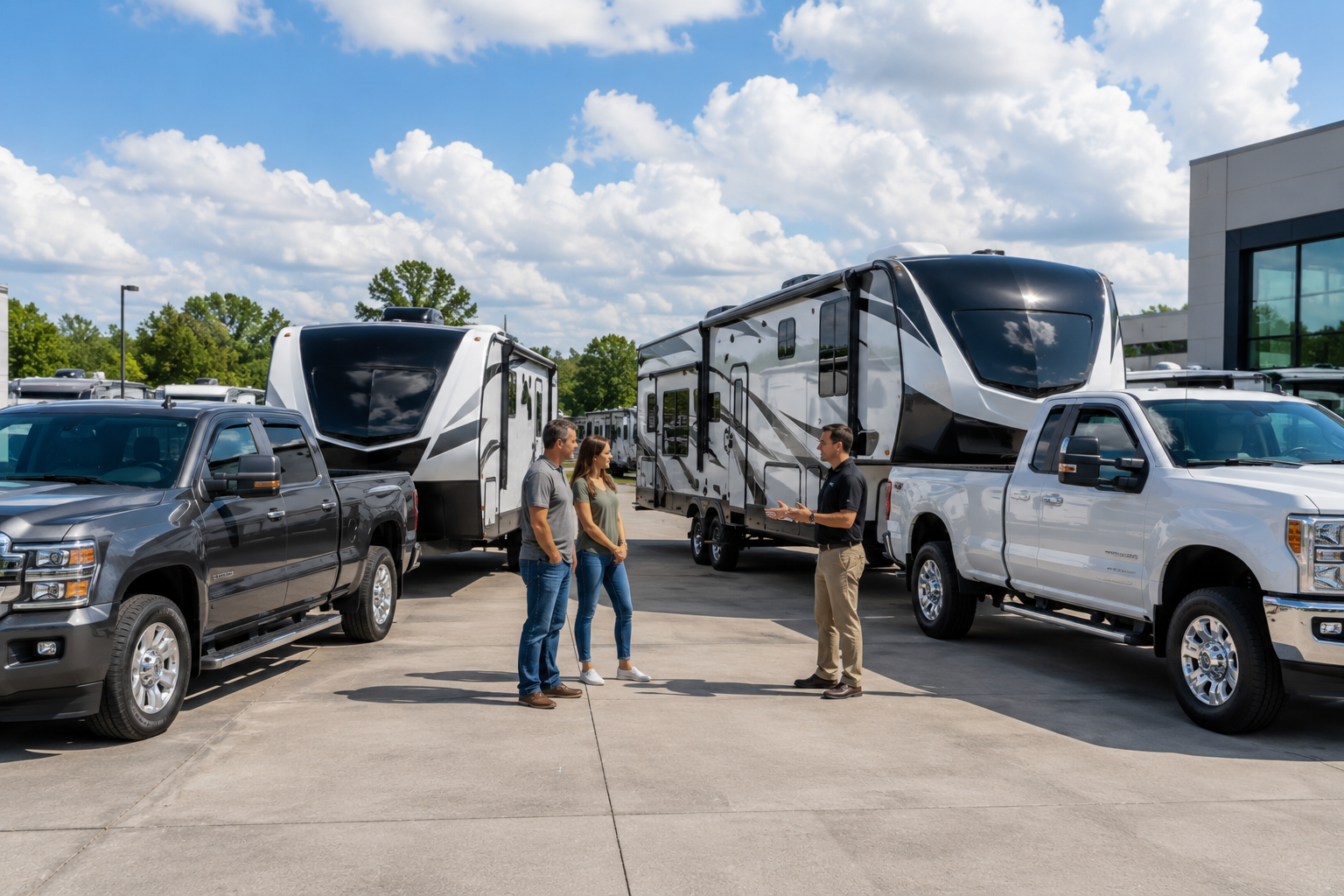
Before choosing a trailer, gather the exact specifications for your truck.
Then compare those numbers with the travel trailer you are considering.
A good shopping process is:
Find your truck's payload rating.
Verify its exact maximum tow rating.
Confirm GVWR and GCWR.
Estimate passenger and cargo weight.
Estimate loaded trailer weight.
Estimate realistic tongue weight.
Include the hitch and accessories.
Confirm tire and axle ratings.
Leave a practical safety margin.
Verify the setup before purchasing.
This approach is far more reliable than choosing a trailer because the brochure describes it as "half-ton towable."
What Does "Half-Ton Towable" Actually Mean?
You may see RV manufacturers or dealerships describe certain travel trailers as half-ton towable.
Treat that phrase as a starting point, not a guarantee.
There are dozens of half-ton truck configurations with different payload and towing ratings.
A trailer that pairs well with a properly equipped F-150 Max Tow configuration may exceed the practical limits of another half-ton truck with a different engine, axle ratio, cab, or payload rating.
Your specific truck's ratings always take priority over a marketing label.
Final Verdict: Can a Half-Ton Truck Tow a Travel Trailer?
Yes. Many half-ton trucks are excellent tow vehicles for travel trailers.
The key is choosing the right trailer rather than simply choosing the largest trailer that falls beneath the truck's advertised tow rating.
For many buyers, a lighter or moderately sized travel trailer provides the best balance between interior space and comfortable towing.
Before buying, verify:
Truck payload
Maximum towing capacity
GVWR
GCWR
Trailer GVWR
Expected tongue weight
Passenger and cargo weight
Hitch capacity
Zoomers RV carries a wide range of travel trailers, including lightweight and larger family floorplans, which makes it possible to compare RV size, weight, sleeping capacity, and layout against your actual tow vehicle before deciding. Zoomers also publishes detailed towing guidance to help shoppers understand how truck and trailer ratings work together.
Frequently Asked Questions
What Size Travel Trailer Can a Half-Ton Truck Pull?
It depends on the specific truck.
Many properly equipped half-ton trucks can tow moderate-size travel trailers, but payload, tongue weight, GCWR, hitch rating, and loaded trailer weight must all be checked before deciding.
Is 7,000 Pounds Too Heavy for a Half-Ton Truck?
Not necessarily.
Some half-ton trucks are capable of towing a properly loaded 7,000-pound trailer, while other configurations may be limited by payload or other ratings.
Check the exact truck's specifications rather than relying on the model name alone.
Does Trailer Tongue Weight Count Against Payload?
Yes.
The trailer's tongue weight presses down on the truck and therefore uses part of the truck's available payload capacity.
Passengers, cargo, and hitch equipment also count against payload.
Should I Use Dry Weight or GVWR When Choosing a Travel Trailer?
GVWR provides a more conservative planning figure because it represents the maximum loaded weight of the trailer.
Dry weight does not include all the supplies, water, food, batteries, propane, and camping equipment you may add.
Can an F-150 Tow a Travel Trailer?
Many Ford F-150 configurations can tow travel trailers, but the allowable trailer weight varies substantially according to engine, drivetrain, axle ratio, cab, bed length, payload, and towing equipment.
Always verify the ratings for the exact truck.
Can a Silverado 1500 Tow a Travel Trailer?
Yes, many Silverado 1500 configurations can tow travel trailers.
As with any half-ton truck, the specific truck's payload, tow rating, GCWR, hitch rating, and trailer tongue weight must be checked before towing.
Do I Need a Three-Quarter-Ton Truck for a Travel Trailer?
Not necessarily.
Many travel trailers pair well with half-ton pickups.
A three-quarter-ton truck becomes more attractive when trailer weight, tongue weight, passengers, cargo, or long-distance towing demands begin pushing a half-ton close to its limits.