How to Live in an RV with a Family
Living in an RV with your family is one of the most deliberate lifestyle choices a household can make. It means trading square footage for freedom, a fixed address for flexibility, and a mortgage for a monthly campground rate. Thousands of families across the United States are doing it right now — not as a temporary adventure but as a permanent way of life — and the ones who make it work all started with the same thing: the right information before they made the move.
This guide gives you the practical, honest picture of what full-time RV family life actually involves — from choosing the correct rig for your family's size to managing schooling, budgets, space, and the daily rhythms that keep everything functioning.
Choosing the Right RV for Your Family
The floor plan you choose shapes nearly every aspect of daily family life. This is not a decision to make based on price alone or on what looks impressive in a showroom walk-through. It is a decision that affects where everyone sleeps, how mornings flow, where the kids do schoolwork, and whether you have enough room to store three months of groceries and outdoor gear without the interior becoming unlivable.
For most families of three or more, the decision narrows quickly to two categories: fifth wheels and toy haulers.
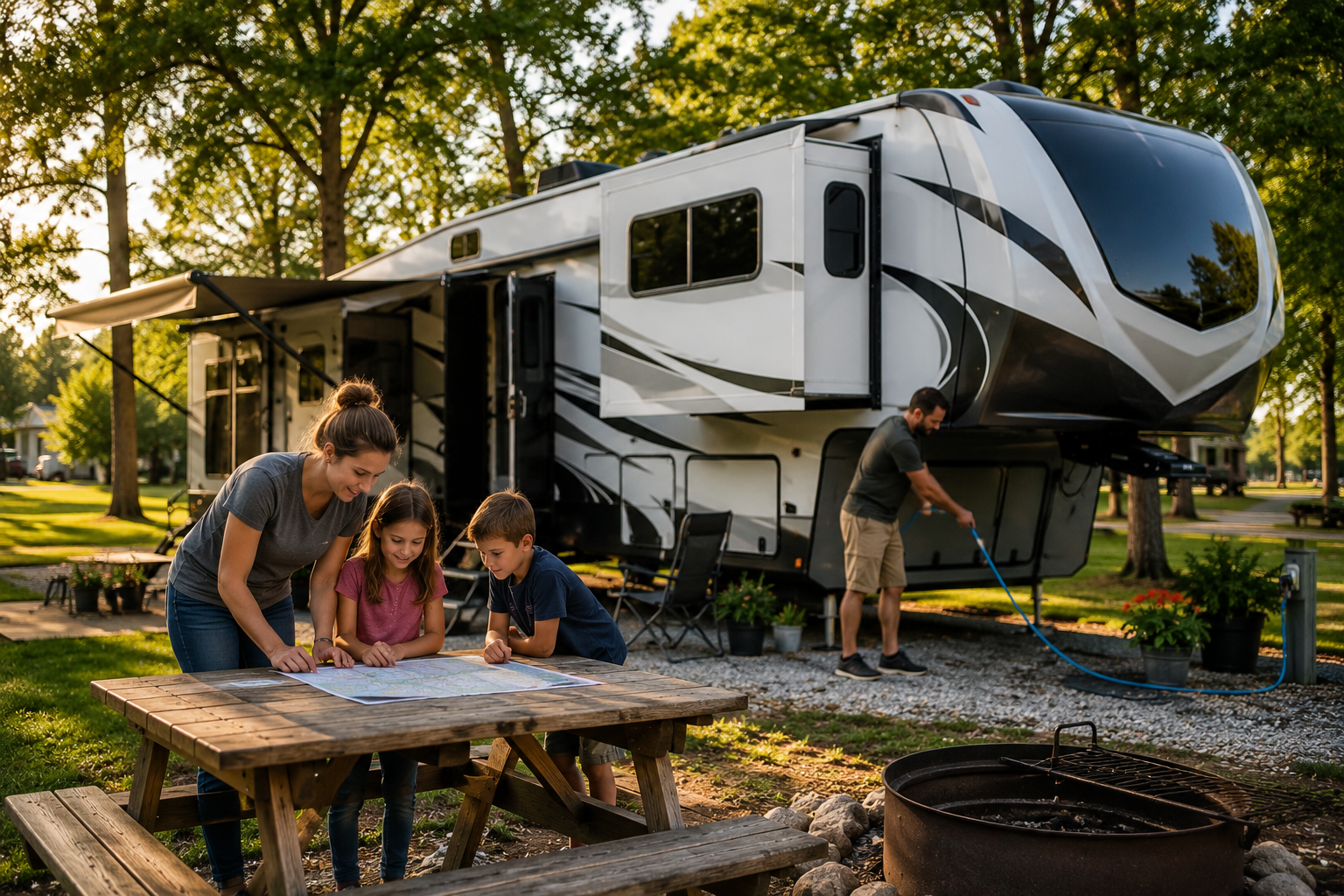
Fifth wheels offer the best combination of living space, structural durability, and floor plan variety for full-time family use. The bi-level construction creates natural separation between adult and children's sleeping areas — a detail that sounds minor until you are 60 days into full-time living and everyone desperately needs genuine privacy. Models in the 38 to 44-foot range with rear bunk rooms, multiple slide-outs, and residential kitchen packages are what experienced full-time family buyers consistently land on after doing serious research.
Toy haulers are the right answer for families with older kids, teenagers, or a household full of outdoor gear — bikes, kayaks, boards, or powersports equipment. The rear garage converts into a second living or sleeping zone at night, effectively doubling the functional use of the space. Zoomers RV is the largest toy hauler dealer in Indiana and carries an extensive selection of new and current-year toy haulers that are genuinely well-suited for family use.
What Features Actually Matter for Family Full-Time Living
Beyond size, the features that separate a livable family rig from a frustrating one come down to a short list:
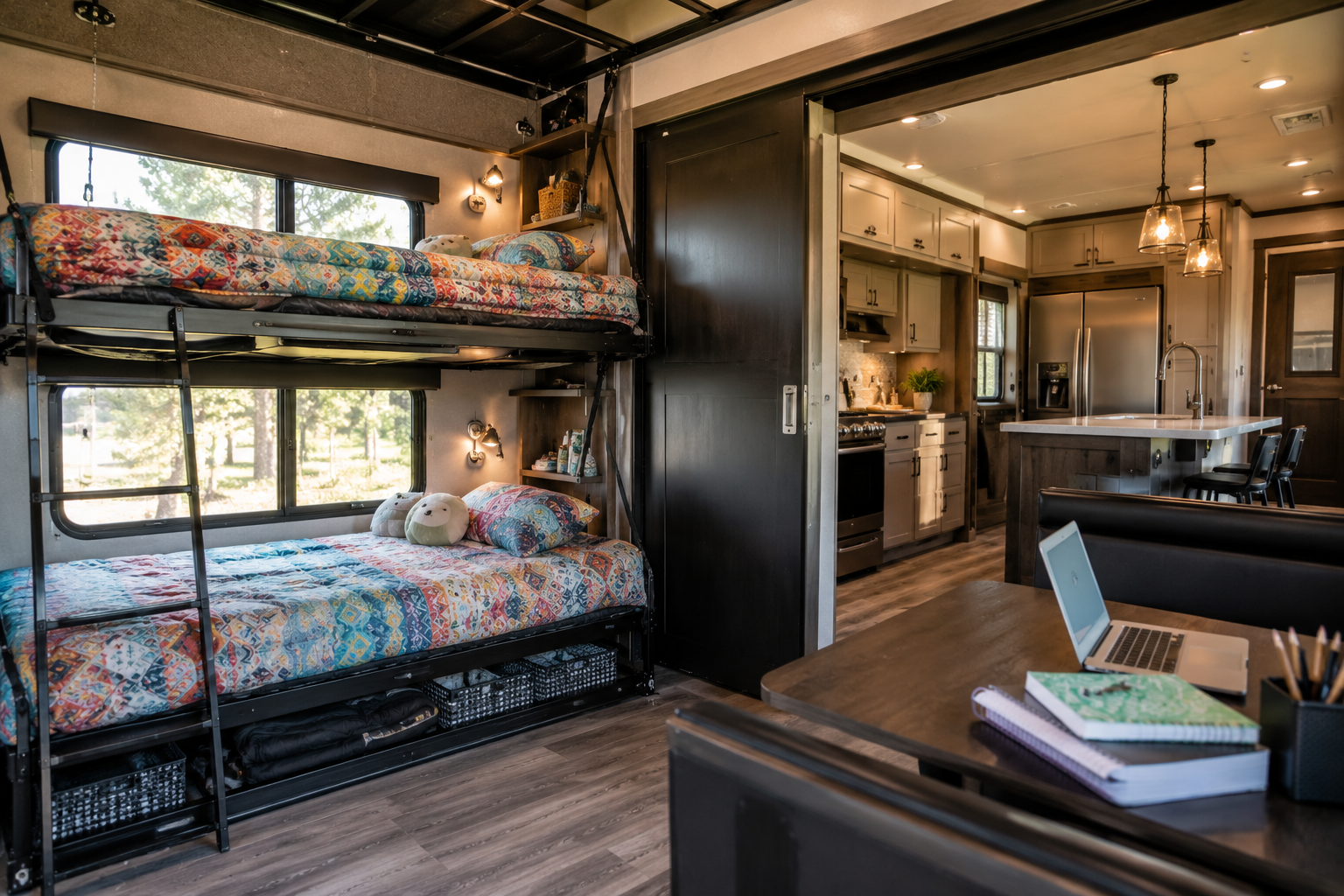
A rear bunk room with a proper door, individual reading lights, and dedicated storage — not just a curtain-divided alcove
A full-size residential refrigerator that can hold a week of groceries for four to six people
A real oven and a kitchen with counter space that allows two people to work simultaneously
At least one and a half bathrooms — the half-bath alone eliminates the single biggest morning friction point in small-space family living
A fixed dinette or freestanding desk area for schoolwork and remote work
Laminated wall and floor construction rather than staple-built framing, which deteriorates rapidly under full-time use conditions
The Real Monthly Cost of Full-Time RV Family Life
The finances of full-time RV living are both simpler and more variable than most people expect. Simpler because your core monthly expenses are predictable once your rig is paid for. More variable because campground choices, travel pace, and fuel costs swing the monthly total significantly.
A realistic baseline for a family of four runs between $2,500 and $4,500 per month. Here is where that money typically goes:
Campground fees are the largest single variable — full-hookup RV resort rates can run $900 to $1,500 monthly while state parks, county campgrounds, and monthly rates at smaller parks can bring that down to $600 or less
Fuel is the second biggest variable and is almost entirely controlled by how often you move — families who stay two to three weeks at each location instead of moving every few days reduce fuel spend by 40 to 60 percent
Groceries for a family of four run similarly to a conventional household, typically $500 to $900 monthly
RV-specific full-timer insurance runs $100 to $200 per month and is structured differently than standard vacation RV policies
Internet connectivity — typically two cellular data plans with a signal booster — adds $150 to $250 monthly
A realistic maintenance and repair reserve of $150 to $300 monthly is not optional — it is the difference between a manageable breakdown and a financial crisis
One financial reality that surprises most first-year families: the total monthly cost of full-time RV life is often less than the combined cost of a mortgage, utilities, and the consumer spending habits that a fixed address tends to generate.
Schooling on the Road — More Manageable Than You Think
Education is the concern that stops more families at the planning stage than any other single factor. It should not. The full-time RV community has built a well-developed ecosystem of educational options that work across every travel pattern, every state, and every learning style.
The most common approach is a structured online homeschool curriculum. Platforms like Time4Learning and Connections Academy deliver grade-level coursework that children can complete on their own schedule — a critical advantage when mornings might involve a hike, a museum, or a travel day rather than a fixed school hour.
Project-based and experiential learning is the approach families lean into most naturally over time. A family traveling through the Midwest covers agriculture, economics, and geography not through worksheets but through actual exposure to the places and industries that make up the country. A child who helps plan a route, manage a weekly campsite budget, and navigate a new town is building applied skills that no classroom replicates efficiently.
Your legal domicile state determines which homeschool regulations apply. South Dakota, Texas, and Florida are the three most popular domicile states for full-time families precisely because their homeschool reporting requirements are minimal and their residency processes are straightforward.
Living Well in a Small Space — Organization and Routine
Small spaces are either organized or chaotic — there is very little middle ground. Families who thrive in RVs treat organization not as a preference but as an infrastructure decision that gets made once and then maintained as a daily habit.
The most effective single rule: every item has one assigned place and returns to it every time. Deviation from this compounds quickly in 400 square feet.
Practical organization habits that make a measurable difference in daily life:
Each family member owns one personal storage bin — everything they want to keep must fit inside it, no exceptions
Vertical storage through wall-mounted hooks, over-door organizers, and mounted shelving recovers significant usable space that floor storage wastes
Outdoor gear, sports equipment, and bulk items live in a cargo carrier or storage box mounted externally to the hitch — not inside the living area
A 10-minute reset at the end of each evening keeps the following morning from starting under a pile of yesterday's chaos
Routine matters just as much as organization. When each family member knows what their morning looks like, when quiet time is protected, and who has responsibility for which campsite tasks, the shared space starts functioning more like a coordinated household and less like an overcrowded vehicle.
Finding Community and Staying Connected
The social concern families raise most often before starting full-time RV life almost always dissolves within the first few weeks on the road. Campgrounds are communities. Full-time RV families are everywhere, and the culture within that community is one of the most openly supportive you will find anywhere.
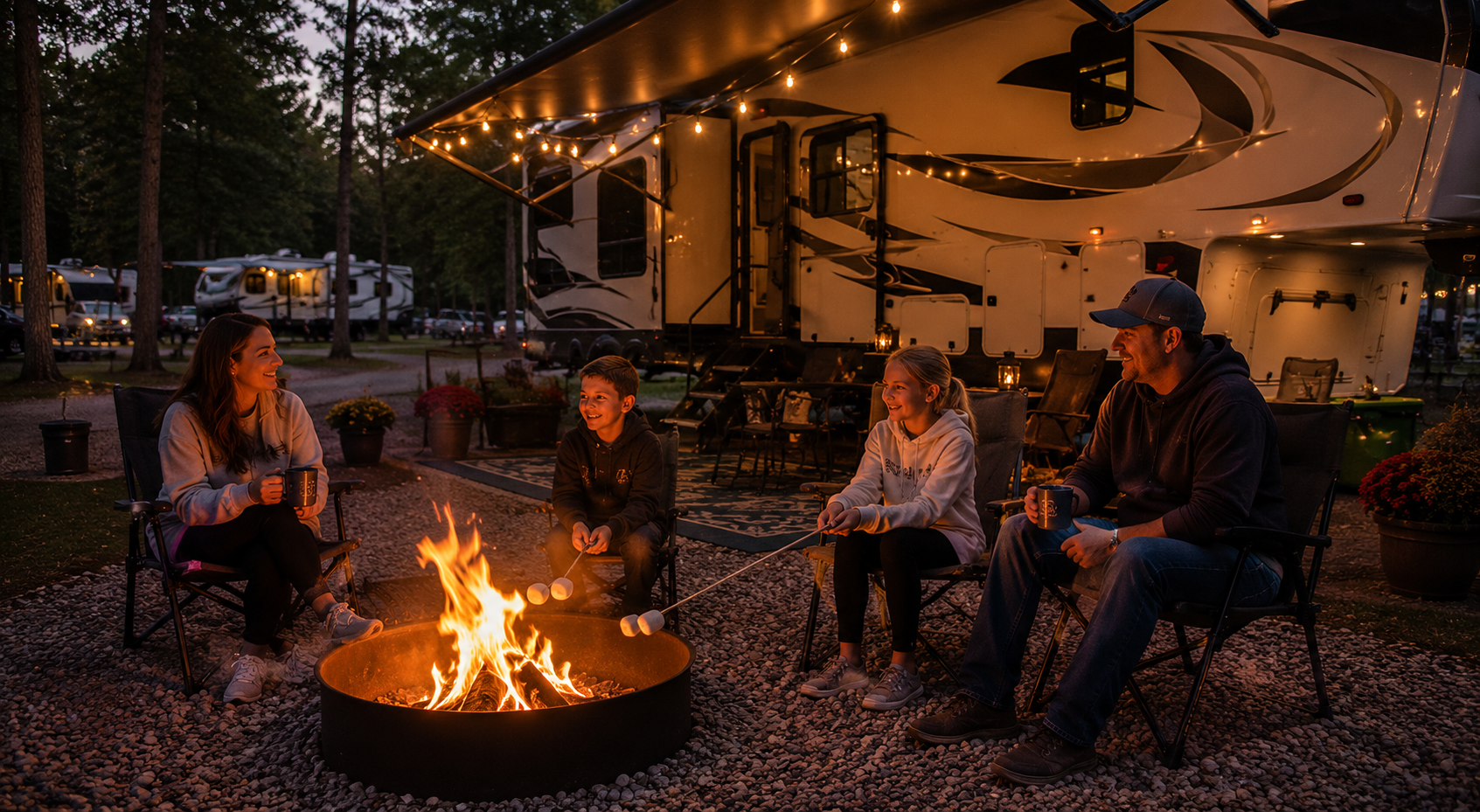
Kids build friendships at campfire circles and shared playgrounds. Parents exchange campground recommendations, repair referrals, and route suggestions across picnic tables. The shared experience of figuring out an unconventional lifestyle creates a level of mutual openness that suburban neighborhoods rarely generate.
Apps like Campendium and The Dyrt help families find campgrounds with strong family reviews before booking. Online communities on Facebook and Reddit provide real-time support when something breaks far from a service center — and something will break, usually at the least convenient possible moment.
Picking the Right Rig Is Where Everything Starts
Every element of this guide — the budget, the schooling logistics, the daily routine, the community experience — is easier when the rig itself is right. A family in a fifth wheel with a functional bunk room, a proper kitchen, and solid construction tolerates the small-space realities of full-time living because their environment supports it. A family crammed into an undersized rig with a poorly designed floor plan burns through goodwill fast.
Zoomers RV carries new and used fifth wheels, toy haulers, travel trailers, and Class C motorhomes across locations in Indiana, Iowa, and Illinois — with a team that works regularly with full-time family buyers and understands which floor plans and brands hold up under real daily use conditions. The inventory spans brands including Jayco, Forest River, Keystone, Coachmen, and Alliance RV — the manufacturers experienced full-time families consistently land on after researching seriously.
Whether your family is testing the idea with a quality used travel trailer or committing to a full-time fifth wheel built for daily living, the conversation starts with understanding exactly how your family moves through a day — and building outward from there.